Cairo and Alexandria, 3-day private tour from Cairo
Day 1: Arrival and Cairo
Are you already in Cairo? Arriving by plane? No problem. Our team will meet you at your hotel or the airport. You will be accompanied each day by a German-speaking Egyptologist who will also plan the order of your visits individually. This way, you'll avoid the tourist crowds. He will tell you a great deal about the country and its people, both ancient and modern. You will begin your sightseeing tour directly in a modern, air-conditioned vehicle (car/minivan).
Visit to the Grand Egyptian Museum (GEM)
Alternatively, you can visit the Grand Egyptian Museum (GEM). With its 81,000 m² of floor space, the GEM is the largest archaeological museum in the world. The museum opened on November 1, 2025, and has been open to the public since November 4, 2025. A large number of the collection items come from the Egyptian Museum in Cairo. The main attraction is the almost complete display of the funerary objects of King Tutankhamun, which could never be fully displayed in the Egyptian Museum due to lack of space.
Old Town and El Khalili Bazaar
The Old City is Cairo's Islamic quarter, whose history stretches back over a thousand years. El-Moaz Street is a pedestrian zone with the largest concentration of Islamic architecture. Observe authentic Egyptian life on El-Moaz Street. Egyptian culture is a blend of diverse influences, with Arabic as the predominant language. The predominant religion is Islam; Christians make up only about 20% of the population.
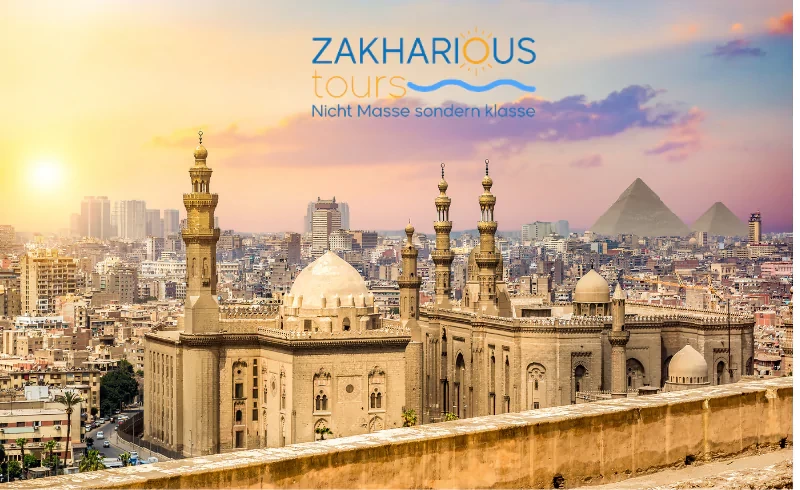
During your walk, you will pass the oldest and largest Ibn Tulun Mosque, the Sultan Hassan Mosque, and the Alabaster Mosque in the Citadel of Saladin. Your walk ends at the Khan El Khalili Bazaar, a lively medieval bazaar where you can discover some curiosities.
The evening
After these initial, unusual impressions of Cairo, you will travel to your hotel. There you will spend the evening and enjoy a sumptuous dinner.
Tag 2: Alexandria
After breakfast, your journey continues to Alexandria. During the approximately 3-hour drive, you'll gain further impressions of Cairo and your first glimpses of Alexandria. You'll travel directly to the Pharos Peninsula on the Mediterranean Sea.
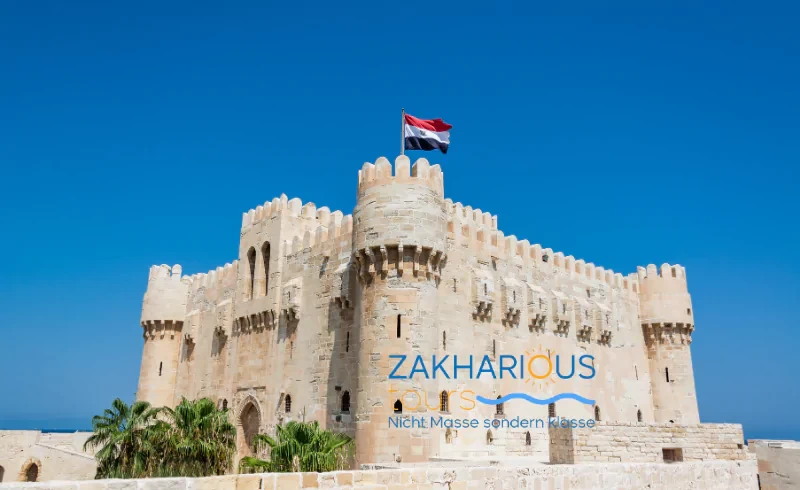
Qaitbay Citadel
The citadel was originally built on the ruins of the ancient Pharos, using the foundations and the destroyed lighthouse as building materials. Later, it was expanded with fortified walls. The citadel then served as a coastal defense against the Ottomans. As the Ottoman Empire weakened, the citadel also lost its military significance. During the British landing in 1882, a large part of the citadel was destroyed, particularly the west facade. Repairs began in 1882. After the 1952 revolution, the building became a naval museum. Today, the Qaitbay Citadel houses, among other things, a maritime museum.
Lighthouse of Alexandria
Once one of the Seven Wonders of the Ancient World, the original lighthouse no longer exists, having been destroyed by an earthquake in the Middle Ages. The Qaitbay Citadel now stands on its site. The lighthouse served as a navigational aid in the complex and dangerous harbor of the important city of Alexandria. At the same time, it was a symbol of Egypt's wealth and power. At 115 to 160 meters tall, it was the first historically recorded lighthouse and remained the tallest ever built until the 20th century. Its remains now lie underwater and are being archaeologically investigated to reconstruct its history.
Abu-I-Abbas-al-Mursi-Moschee
One of the most beautiful and famous mosques in Alexandria is the Abu al-Abbas al-Mursi Mosque, located on the Pharos Peninsula. The present mosque impresses with its four domes and 73-meter-high minaret. Built between 1929 and 1945 in the Neo-Mamluk style, it is dedicated to the Sufi mystic Abu al-Abbas al-Mursi, who is also buried there.
Catacombs of Kom El Shoqafa
The catacombs of Kom El Shoqafa date back to the Roman period, the 1st to 4th centuries. They are considered the largest known Roman burial site in Egypt and reflect the multicultural history of Alexandria. Kom El Shoqafa showcases the unique fusion of Egyptian, Greek, and Roman burial traditions. The catacombs were discovered by chance in 1900 when a donkey fell into a hidden shaft. The complex consists of three levels hewn into the rock, containing tombs, sarcophagi, and ceremonial chambers, with the lowest level often flooded.
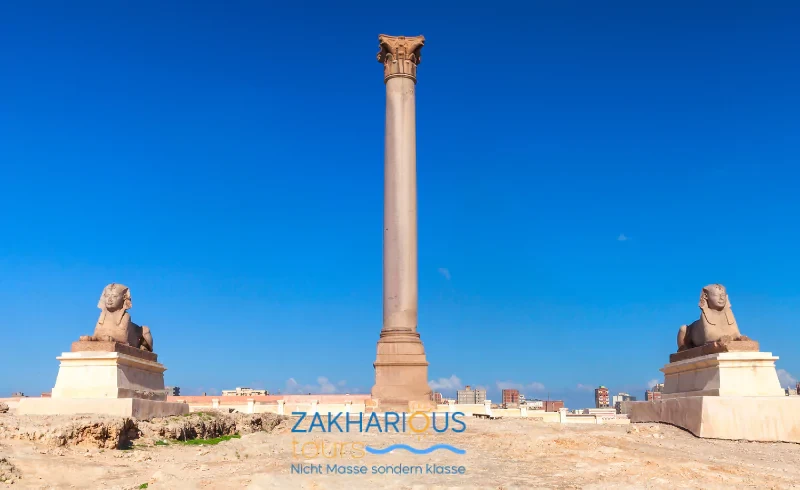
Pompey's Column
Pompey's Column was erected around 297 AD in honor of Emperor Diocletian, not Pompey himself, as its name might suggest. It stands on the site of the Serapeum, the famous main temple of Alexandria. Depending on the source, the column is approximately 26.58 to 28.80 meters tall, making it the tallest freestanding column outside of Rome and Constantinople.
Return to Cairo and the evening
Your tour of Alexandria ends here. You will return to your hotel in Cairo. Spend the evening relaxing and enjoying a delicious dinner.
Day 3: Cairo – Departure
After breakfast, you will check out of the hotel. Today's itinerary includes another visit to Cairo.
Citadel of Saladin
The Citadel was built between 1176 and 1183 by Sultan Saladin to defend against the Crusaders. It subsequently served as the seat of the Egyptian king and government for 700 years. Today, the Citadel of Saladin is part of the UNESCO World Heritage Site "Historic Cairo." It houses several mosques, including the magnificent Muhammad Ali Mosque, also known as the Alabaster Mosque. The al-Nasir Muhammad Mosque and the Sulayman Pasha Mosque are also located within the Citadel. Furthermore, the National Military Museum, the Police Museum, and the Carriage Museum are situated within the walls, as well as the Al-Gawhara Palace of Muhammad Ali Pasha, which itself contains museum exhibits.
Coptic Quarter
The Coptic Quarter lies on the site of the Roman fortress of Babylon and is a historic Christian district that existed even before the Muslim Fatimids founded Cairo in 969 AD. The quarter is considered a stronghold of Christianity in Old Cairo and contains places of worship from a time when the pharaonic religions had died out and Islam had not yet taken hold. Some of the earliest churches have survived to this day, some dating back to the 4th century. It is believed that the Holy Family lived here briefly during their flight from Herod.
Hanging Church
The church's unique construction gave it its name. It was built on the walls above a gatehouse of the Roman fortress of Babylon, giving the impression that it is suspended above the passageway. The Hanging Church is reached by climbing 29 steps. It combines Coptic and Byzantine elements and was built in the style of a basilica. The interior is richly decorated, and the marble pulpit is supported by 13 columns, symbolizing Jesus and the 12 apostles. The church also houses 110 icons, the oldest of which dates back to the 8th century.
The church was likely used as early as the 3rd century AD, making it the oldest Christian site in Egypt. However, the current structure dates back to the 9th century. From the 11th to the 13th centuries, the Hanging Church served as the official residence of the Coptic Patriarch of Alexandria, after the seat of the Coptic Orthodox Church was moved to Cairo. To this day, the church remains an active place of worship and pilgrimage.
departure
Towards evening, your tour guide will take you back to your hotel, the train station, or the airport. He will ensure that you can begin your journey home on time.

 en
en Deutsch
Reviews Summary
Based on 0 reviews
Write Your Own Review