Itinerary: Private 4-day tour of Cairo and Fayum from Cairo
Day 1: Arrival – Egyptian Museum – Old City – Khan El Khalili Bazaar
After your individual arrival, your tour guide will meet you at the agreed location (airport, train station, hotel). As a qualified German-speaking Egyptologist, he will accompany you and share fascinating insights into ancient and modern life in Cairo and Egypt. He will plan the order of your visits individually, allowing you to avoid the tourist crowds. Naturally, he will also arrange lunch for you each day at a restaurant. Then you can begin your sightseeing tour.
Visit the Grand Egyptian Museum (GEM)
you arrive early in the morning, you can visit the Grand Egyptian Museum.
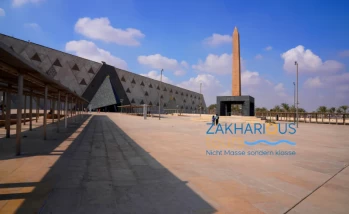
The Egyptian Museum (GEM), located in close proximity to the pyramids, was built between 2009 and 2024. With its 81,000 square meters, it is currently the largest museum in the world. Exhibits, statues, and mummies from ancient Egypt are on display. The highlight of the GEM is undoubtedly the complete collection of artifacts from the tomb of the famous Pharaoh Tutankhamun, which can be seen here for the first time.
Old Town and El Khalili Bazaar
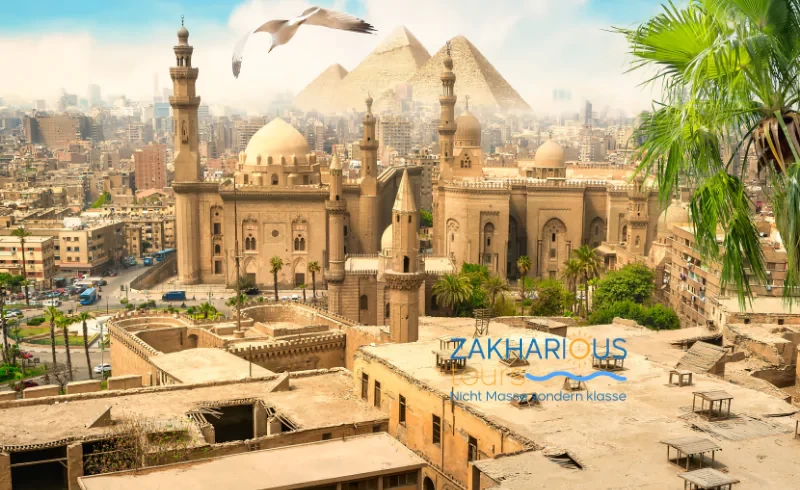
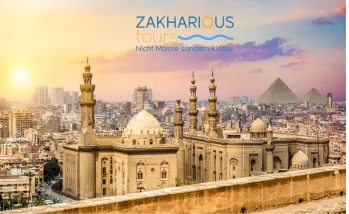
The Old City is Cairo's Islamic quarter, whose history stretches back over a thousand years. El-Moaz Street is a pedestrian zone with the largest concentration of Islamic architecture. Observe the everyday life of Egyptians on El-Moaz Street. Egyptian culture is a blend of diverse influences, with Arabic as the predominant language. The predominant religion is Islam; Christians make up only about 20% of the population.
During your walk, you will pass the oldest and largest Ibn Tulun Mosque, the Sultan Hassan Mosque, and the Alabaster Mosque in the Citadel of Saladin. Your walk ends at the Khan El Khalili Bazaar.
The evening
You'll check into your hotel in the evening. If you'd like to explore Cairo on your own, your tour guide will surely have some suggestions for you. You'll end the day with a delicious dinner.
Optionally, you have the opportunity in the evening to watch the impressive sound and light show at the pyramids. During this evening spectacle, the pyramids and the Sphinx are illuminated, and their history is recounted. Your tour guide will be happy to arrange this for you.
Tag 2: Al-Fayum
Today you will travel to Al-Fayum, located 100 km southwest of Cairo. Al-Fayum is one of the oldest cities in Egypt, with settlement beginning as early as the 5th century BC.
Wadi El-Hitan (Tal der Wale)
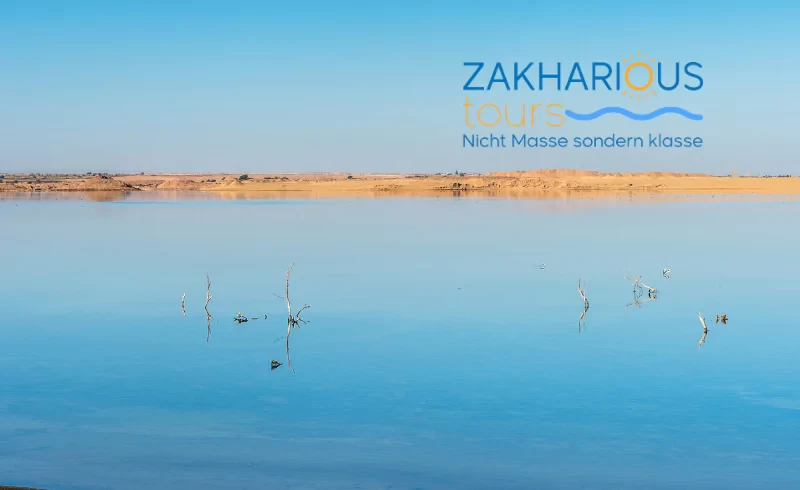
Wadi El-Hitan is a dry valley near Al-Fayum. It is part of the UNESCO World Heritage Site and the Wadi El-Rayan Protected Area. Within this 1,759 km² protected area are numerous fossil remains of an early extinct suborder of whales. During the Eocene epoch, this area was part of the Tethys Ocean. Tectonic forces uplifted the sea, and it was subsequently pushed back, embedding the remains of marine life in the sediment.
The area today contains the fossilized skeletons of private whales and traces of past marine life, such as shark teeth, shells, corals and mangrove roots.
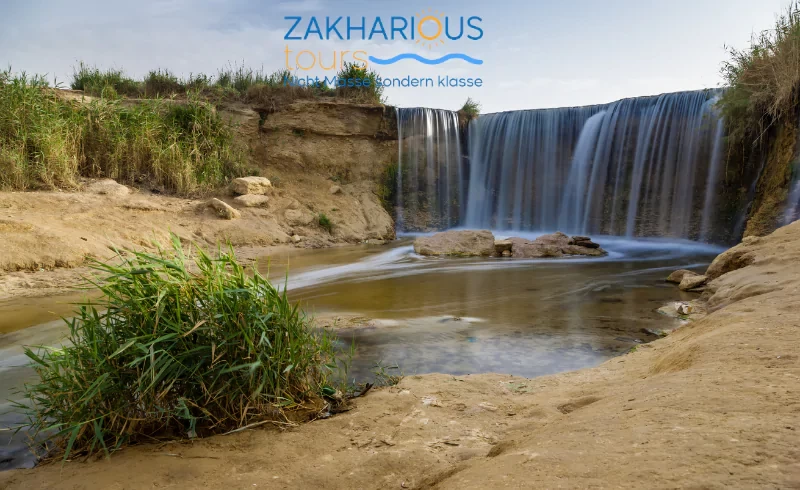
Wadi El Rayan Waterfall
The El-Rayan waterfall is the only and largest waterfall in Egypt. Agricultural runoff from the Fayum Oasis fills two depressions of different elevations, connected by a channel. The waterfall forms where the water from the upper lake flows into the lower one, due to the difference in water levels between the two lakes. Therefore, the waterfall is man-made.
The evening
In the evening you will return to your hotel and end the day with a delicious dinner.
Tag 3: Giza Plateau - Sakkara
Pyramids of Giza, the Great Sphinx and the Valley Temple of Khafre
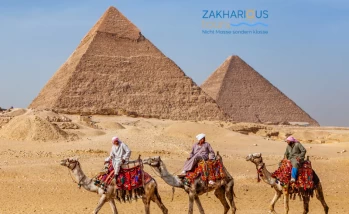
On the western edge of the Nile Valley is the Giza Plateau, where the pyramids, the Great Sphinx and the Valley Temple of Khafre are located.
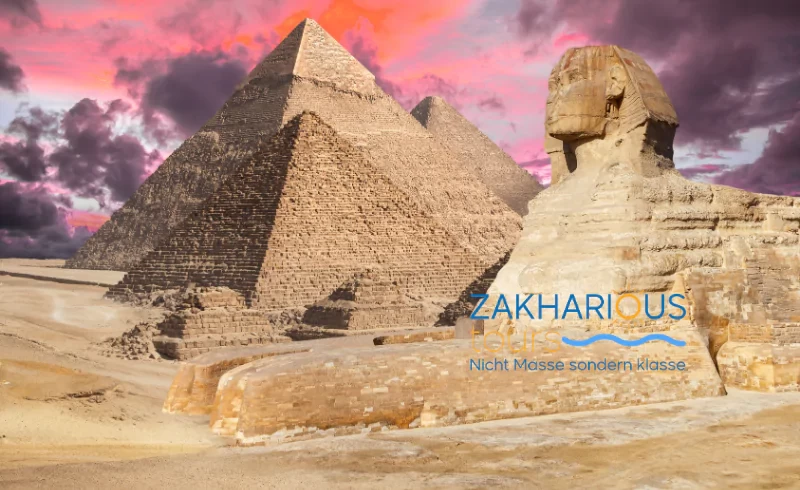
The pyramid field was already an important cemetery during the 1st Dynasty. The Giza pyramids were built between approximately 2620 and 2500 BC and are among the oldest, most famous, and best-preserved structures of humankind. Optionally, you can visit the burial chambers of the three pyramids.
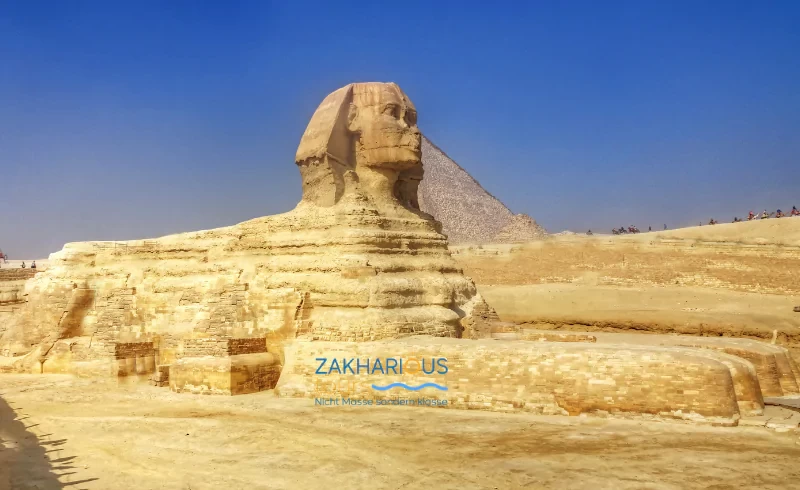
Not far from the pyramids stands the Great Sphinx, by far the most famous and largest. Likely built during the 4th Dynasty, between 2520 and 2494 BC, it has risen from the sands of the Egyptian desert for over 4,000 years. Hewn from the remains of a limestone hill that served as a quarry for the construction of the Great Pyramid of Giza, it depicts a reclining lion with a human head. Afterwards, you will visit the Valley Temple of Khafre, located right next to it.
Step Pyramid of Saqqara
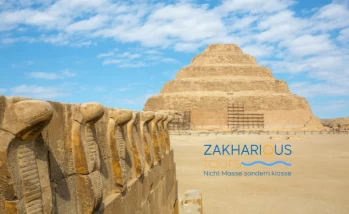
The Step Pyramid of Saqqara is the oldest Egyptian pyramid. Dating from the 3rd Dynasty of the Old Kingdom, around 2650 BC, it was built by Djoser during his 19-year reign. As the centerpiece of a vast tomb complex, it was intended to serve the king in the afterlife. The complex is surrounded by a 10-meter-high limestone wall and encompasses temples, chapels, and other tombs spread across approximately 16 hectares. Carvings and hieroglyphs offer fascinating insights into religious practices and daily life in ancient Egypt.
Pepi-I.-Pyramid
The Pyramid of Pepi I is the tomb of Pharaoh Pepi I, a pharaoh of the 6th Dynasty. Of its original height of 52.5 meters, only a 12-meter-high mound remains, in the center of which gapes a large crater. The core masonry consisted of small pieces of limestone bonded with clay mortar. Of the outer casing, which was made of fine limestone blocks, only the lowest layer survives.
Serapeum in Sakkara
In ancient Egypt, the Serapeum served as a burial and veneration site for the sacred Apis bulls. After their death, the bulls were embalmed and buried in the catacombs of the Serapeum. It was only under Honorius, a Roman emperor, that the Serapeum was closed. Coptic monks living nearby destroyed a large number of the bull mummies.
Tomb of Kagemni
North of the Pyramid of Teti lies the mastaba of Kagemni, an ancient Egyptian vizier under Pharaoh Teti of the 6th Dynasty. The tomb comprises 10 differently constructed interior chambers, depicting scenes of bird-catching, fishing, and offerings, among other things. The three-pillar hall, in contrast, shows scenes of dancing, hunting, and boating.
Day 4: Saladin Citadel – Alabaster Mosque – Coptic Quarter – Hanging Church
After a leisurely breakfast, you will check out of your hotel. Before your flight back, you will have more time to explore Cairo.
Citadel of Saladin
The Citadel is one of the most important monuments in Islamic Cairo. An impressive medieval defensive structure, its strategic location on Muqattam Hill afforded it an excellent defensive position. Enjoy the wonderful panoramic view over Cairo. On a clear day, you can even see the pyramids from here.
The Citadel was built between 1176 and 1183 by Sultan Saladin to defend against the Crusaders. It subsequently served as the seat of the Egyptian king and government for 700 years. Today, the Citadel of Saladin is part of the UNESCO World Heritage Site "Historic Cairo." It houses several mosques, including the magnificent Muhammad Ali Mosque, also known as the Alabaster Mosque. The al-Nasir Muhammad Mosque and the Sulayman Pasha Mosque are also located within the Citadel. Furthermore, the National Military Museum, the Police Museum, and the Carriage Museum can be found within its walls, as well as...
Al-Gawhara Palace of Muhammad Ali Pasha, which itself contains museum elements.
Muhammad-Ali-Mosque (Alabaster-Mosque)
The Muhammad Ali Mosque is one of the grand mosques in Cairo. It is also known as the Alabaster Mosque because its interior is clad in alabaster. The two minarets are an impressive 82 meters tall, and the dome reaches a height of 52 meters. Inside, the large, gold-decorated main dome, measuring 21 meters in diameter, is flanked at the corners by four smaller domes and along the sides by four semi-domes. The interior is illuminated by circular electric lights. The prayer hall features two richly decorated pulpits.
Coptic Quarter
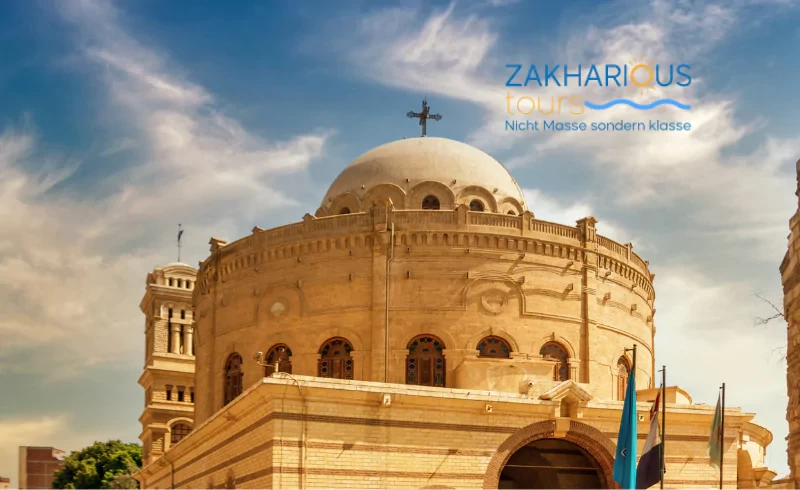
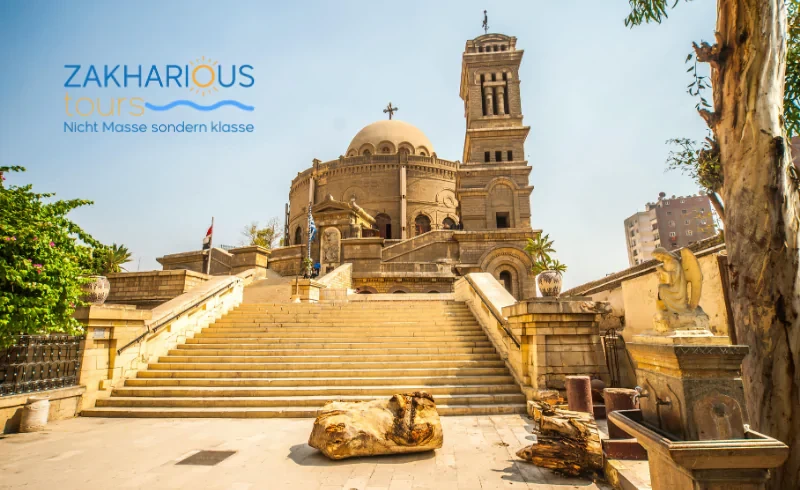
The Coptic Quarter lies on the site of the Roman fortress of Babylon and is a historic Christian district that existed even before the Muslim Fatimids founded Cairo in 969 AD. The quarter is considered a stronghold of Christianity in Old Cairo and contains places of worship from a time when the pharaonic religions had died out and Islam had not yet taken hold. Some of the earliest churches, dating back to the 4th century, have survived to this day. It is believed that the Holy Family lived here briefly during their flight from Herod.
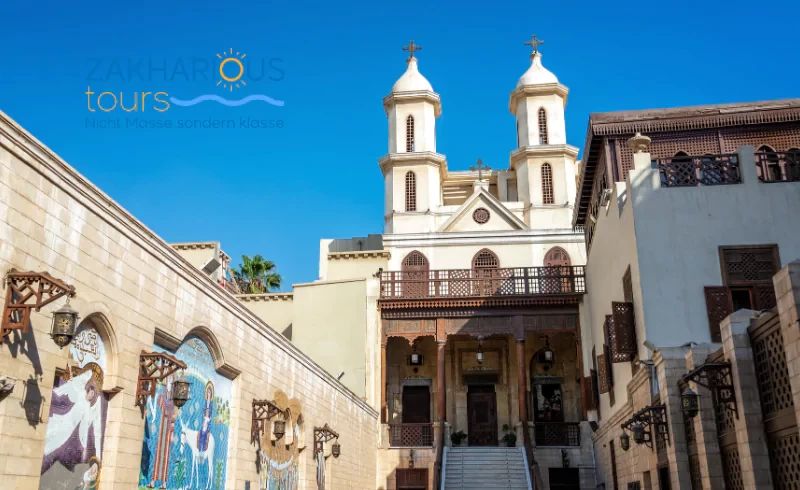
Hanging Church
The church's unique construction gave it its name. It was built on the walls above a gatehouse of the Roman fortress of Babylon, giving the impression that it is suspended above the passageway. The Hanging Church is reached by climbing 29 steps. It combines Coptic and Byzantine elements and was built in the style of a basilica. The interior is richly decorated, and the marble pulpit is supported by 13 columns, symbolizing Jesus and the 12 apostles. The church also houses 110 icons, the oldest of which dates back to the 8th century.
The church was likely used as early as the 3rd century AD, making it the oldest Christian site in Egypt. However, the current structure dates back to the 9th century. From the 11th to the 13th centuries, the Hanging Church served as the official residence of the Coptic Patriarch of Alexandria, after the seat of the Coptic Orthodox Church was moved to Cairo. To this day, the church remains an active place of worship and pilgrimage.
departure
This concludes your 4-day tour. Your tour guide will say goodbye after taking you to the airport or your accommodation.
Write Your Own Review