Private 4-day trip to Cairo and Luxor by plane from Cairo
Tag 1:
Your tour guide, a qualified German-speaking Egyptologist, will meet you at your hotel or accommodation if you are already in Cairo, or pick you up from the airport. From there, your sightseeing tour begins. You will travel in a modern, air-conditioned vehicle (car/minivan), and your private guide will accompany you for both days in Cairo, sharing insights into the country and its people, both ancient and modern. He will also tailor the itinerary to your specific needs, allowing you to avoid the tourist crowds.
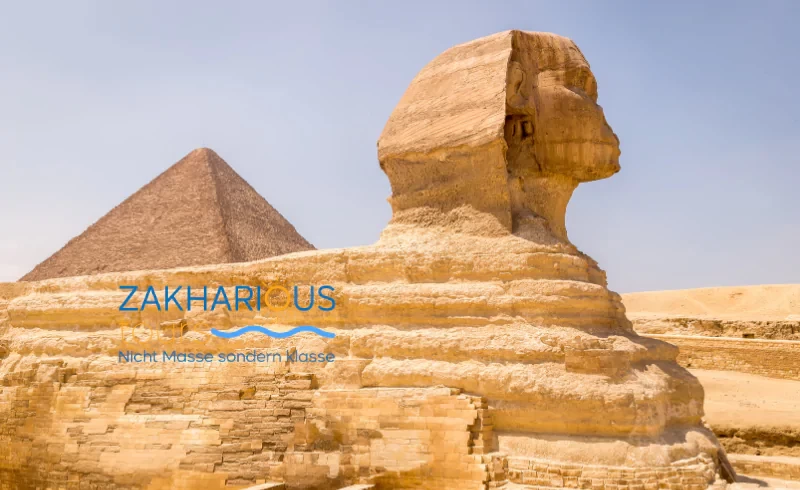
Pyramids of Giza, the Great Sphinx and the Valley Temple of Khafre
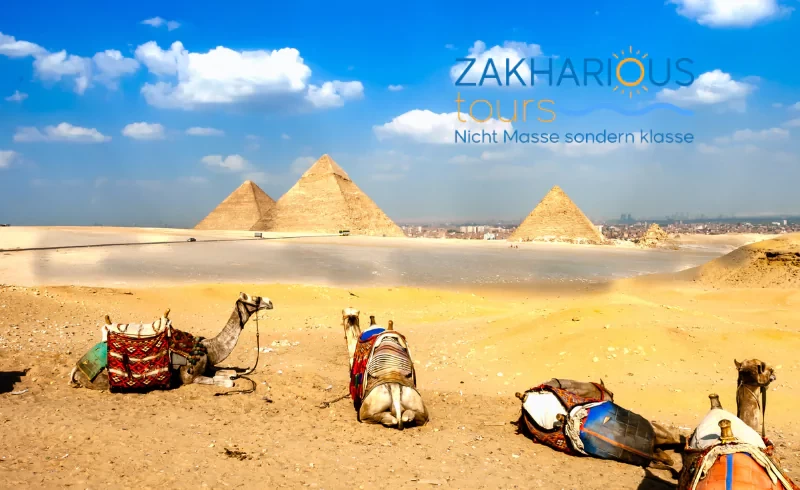
On the western edge of the Nile Valley is the Giza Plateau, where the pyramids, the Great Sphinx and the Valley Temple of Khafre are located.
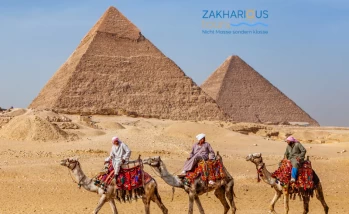
The pyramid field was already an important cemetery during the 1st Dynasty. The Giza pyramids were built between approximately 2620 and 2500 BC and are among the oldest, most famous, and best-preserved structures of humankind. Optionally, you can visit the burial chambers of the three pyramids.
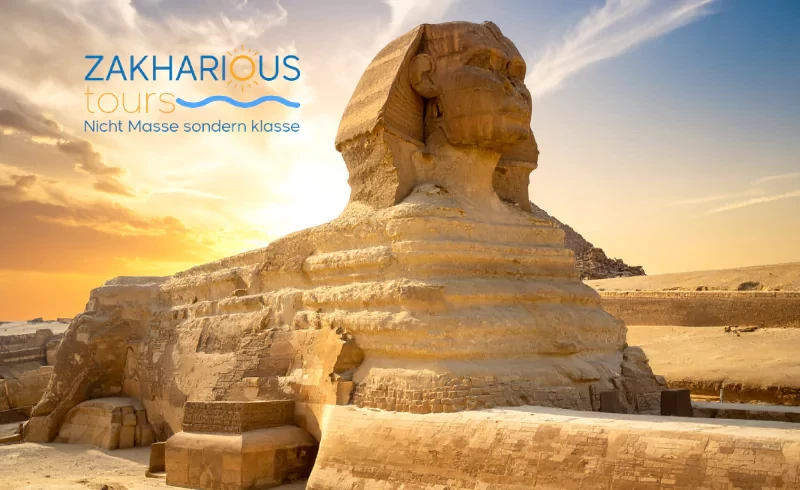
Not far from the pyramids stands the Great Sphinx, by far the most famous and largest. Likely built during the 4th Dynasty, between 2520 and 2494 BC, it has risen from the sands of the Egyptian desert for over 4000 years. Hewn from the remains of a limestone hill that served as a quarry for the construction of the Great Pyramid of Giza, it depicts a reclining lion with a human head.
Visit to the Grand Egyptian Museum (GEM)
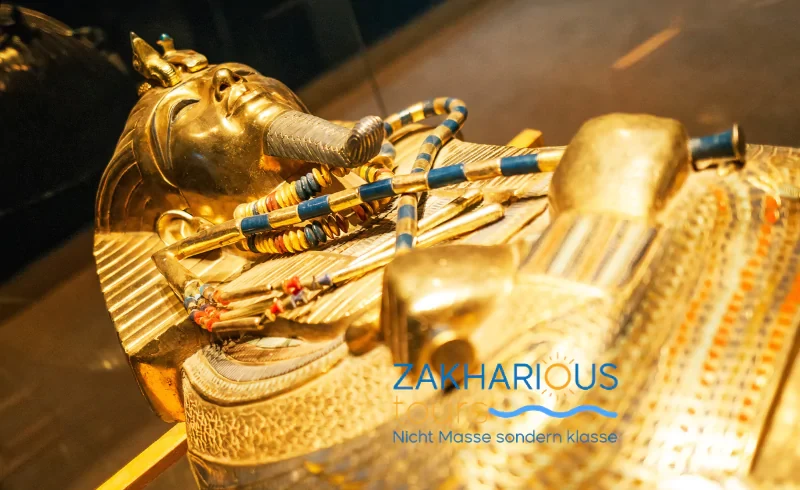
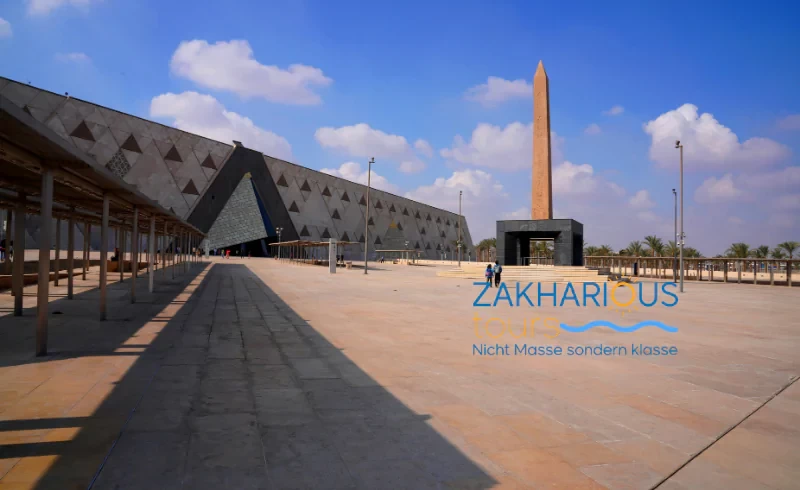
you will visit the Grand Egyptian Museum (GEM). With its 81,000 m² of floor space, the GEM is the largest archaeological museum in the world. The museum opened on November 1, 2025, and has been open to the public since November 4, 2025. A large number of the collection items come from the Egyptian Museum in Cairo. The main attraction is the almost complete display of the funerary objects of King Tutankhamun, which could never be fully displayed in the Egyptian Museum due to lack of space.
Lunch
At lunchtime, your tour guide will take you to a local restaurant. Here you will enjoy a rich and delicious lunch with a view of the pyramids.
You will now travel to your hotel in Cairo with many new impressions and information. Enjoy your dinner and relax a little. Should you wish to explore the city a bit more on your own, your tour guide will surely have a suggestion for you.
Tag 2:
After a hearty breakfast, you will check out of your hotel and continue your tour of Cairo.
Citadel of Saladin
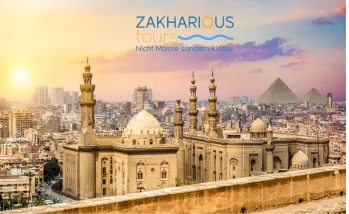
The Citadel was built between 1176 and 1183 by Sultan Saladin to defend against the Crusaders. It subsequently served as the seat of the Egyptian king and government for 700 years. Today, the Citadel of Saladin is part of the UNESCO World Heritage Site "Historic Cairo." It houses several mosques, including the magnificent Muhammad Ali Mosque, also known as the Alabaster Mosque. The al-Nasir Muhammad Mosque and the Sulayman Pasha Mosque are also located within the Citadel. Furthermore, the National Military Museum, the Police Museum, and the Carriage Museum can be found within its walls, as well as...
Al-Gawhara Palace of Muhammad Ali Pasha, which itself contains museum elements.
Muhammad Ali Mosque / Alabaster Mosque
The Muhammad Ali Mosque, also known as the Alabaster Mosque, is one of the grand mosques in Cairo. It was built between 1824 and 1884 in the Ottoman style with Baroque elements. The mosque is called the Alabaster Mosque because its interior walls are clad in alabaster. The two minarets are 82 meters high, and the large dome reaches a height of 52 meters. The courtyard is surrounded by arcades, at the center of which is a large purification fountain.
Islamic Quarter and Khan El Khalili Bazaar
After a stroll along El Moaz Street through the picturesque old town, you'll reach the Khan El Khalili bazaar. Founded in the 14th century as a caravanserai and trading post on the site of a former Mamluk cemetery, the bazaar is considered the largest in Africa. It boasts a multitude of narrow alleyways, shops, cafes, and squares. Besides souvenir, antique, and jewelry shops, there are many traditional craft workshops, and you can discover a number of curiosities.
Coptic Quarter
The Coptic Quarter lies on the site of the Roman fortress of Babylon and is a historic Christian district that existed even before the founding of Cairo by the Muslim Fatimids in 969 AD. The quarter is considered a stronghold of Christianity in Old Cairo and contains places of worship from a time when the pharaonic religions had died out and Islam had not yet taken hold. Some of the earliest churches have survived to this day, dating back to the 4th century. It is believed that the Holy Family lived here briefly during their flight from Herod.
Hanging Church
The church's unique construction gave it its name. It was built on the walls above a gatehouse of the Roman fortress of Babylon, giving the impression that it is suspended above the passageway. The Hanging Church is reached by climbing 29 steps. It combines Coptic and Byzantine elements and was built in the style of a basilica. The interior is richly decorated, and the marble pulpit is supported by 13 columns, symbolizing Jesus and the 12 apostles. The church also houses 110 icons, the oldest of which dates back to the 8th century.
The site was likely used by a church as early as the 3rd century AD, making it the oldest Christian site in Egypt. However, the current structure dates back to the 9th century. From the 11th to the 13th centuries, the Hanging Church served as the official residence of the Coptic Patriarch of Alexandria, after the seat of the Coptic Orthodox Church was moved to Cairo. To this day, the church remains an active place of worship and pilgrimage.
Lunch
Today your tour guide will take you to a local restaurant where you can relax and enjoy a delicious lunch.
The evening
Towards evening, your tour guide will take you to Cairo Airport and say goodbye. You will then embark on your approximately one-hour flight to Luxor. Upon arrival in Luxor, your tour guide will be waiting to greet you. You will be transferred in a modern, air-conditioned vehicle (car/minivan) to your 5-star hotel, where you will have dinner and spend the night.
Optionally, you can attend the sound and light show at Karnak Temple. The show begins with a historical introduction about the founding of the great city of Thebes and the construction of Karnak Temple. It recounts the glorious achievements of some of the great pharaohs, while you listen to a poetic description of the artistic treasures and the great legacy that Karnak Temple holds.
Tag 3
Hot air balloon ride (optional)
Early in the morning, you have the option of taking a hot air balloon ride for an additional fee. You will be taken to the balloon launch site, where the balloons will be inflated and you can board. You will drift over Luxor's monumental buildings, the Temple of Hatshepsut, and the green fields of the farmers, enjoying a fantastic sunrise. You will return to the hotel in time for breakfast.
After breakfast, you will begin exploring Luxor.
Karnak-Temple
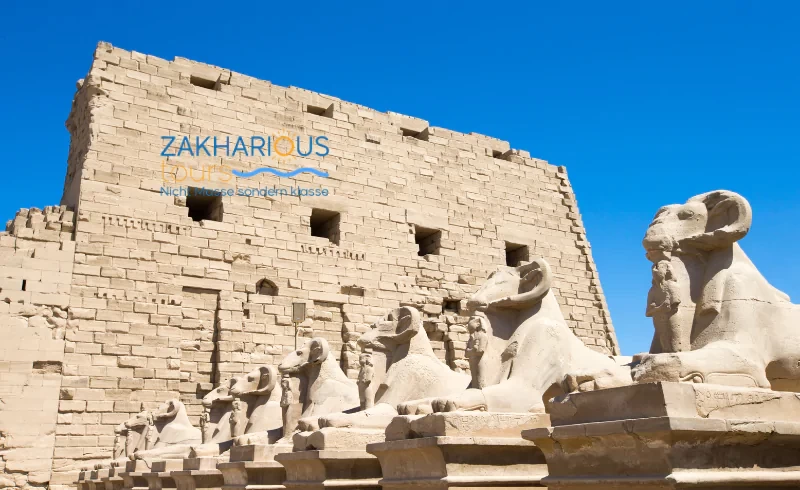
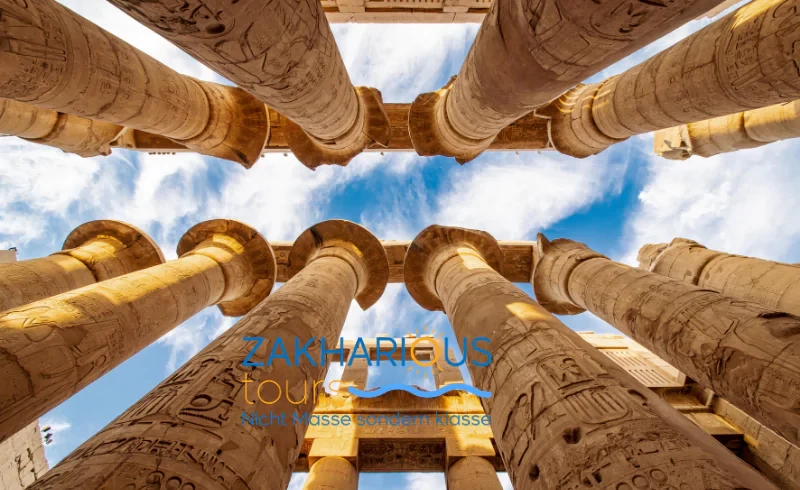
The Karnak Temple in Luxor is the largest temple complex in Egypt. This impressive site is an outstanding relic of ancient Egyptian civilization. Construction began as early as the 16th century BC and continued for many centuries. Closely connected to the temples in West Thebes, it played a central role in the life of ancient Egypt.
Luxor Temple
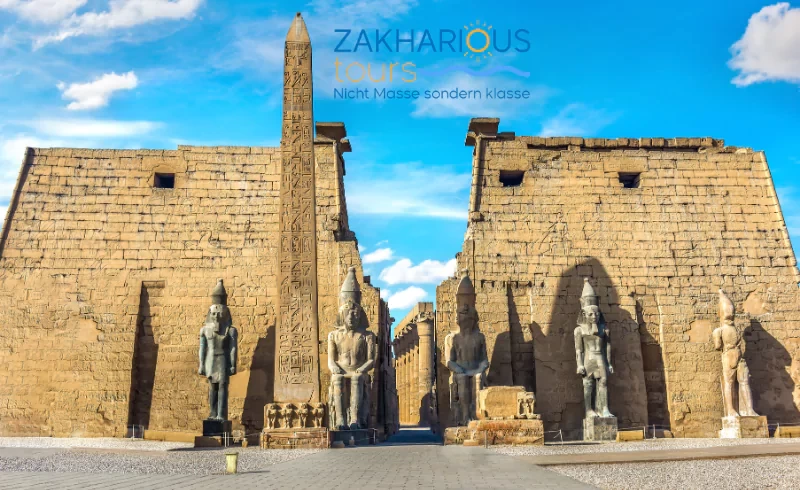
Built during the New Kingdom and known as the southern harem of Karnak, the Luxor Temple was dedicated to the god Amun, his wife Mut, and their son, the moon god Khonsu. The temple essentially served two functions. The Opet Festival was celebrated there on Egyptian New Year, and also on New Year's Day, the king's union with his divine Ka was performed, a ritual first observed at his accession to the throne.
Lunch
They fortified themselves with a lunch of local food at a restaurant.
The evening
You'll end the evening with dinner. Of course, you're free to explore Luxor on your own in the evening. Your tour guide will surely have some tips for you.
Tag 4:
You enjoy a hearty breakfast and then check out of your hotel. There's still a lot on the agenda before you fly back to Cairo.
Valley of the Kings
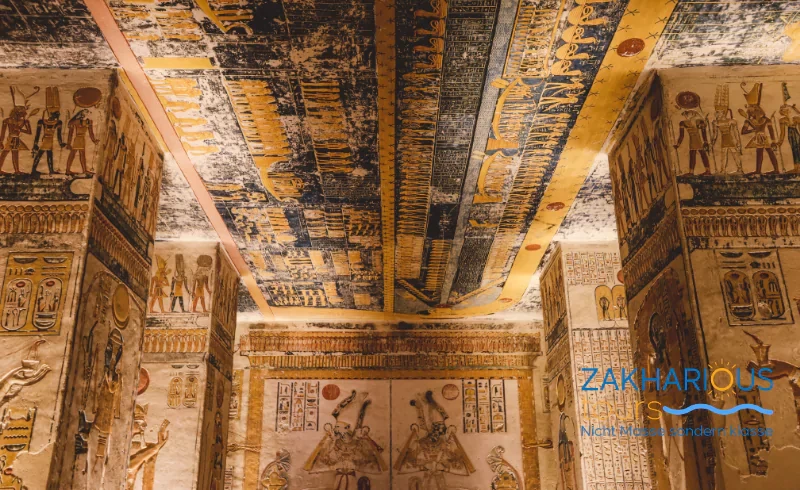
One of Egypt's most important archaeological sites is the Valley of the Kings, located on the west bank of Luxor. This necropolis was once the final resting place of many famous pharaohs, including Tutankhamun. The elaborately designed tombs with their magnificent wall paintings reflect the religious symbolism of ancient Egypt. Your guide will show you three of the most beautiful tombs.
Optionally, you have the opportunity to visit the tombs of Tutankhamun and Ramses VI. Tickets for this can only be purchased on site.
The Temple of Hatshepsut
Also known as Deir el-Bahari, the Temple of Hatshepsut is an architectural masterpiece. Built during the 18th Dynasty for the powerful Queen Hatshepsut, the temple symbolized her extraordinary reign. Let yourself be enchanted by this unique temple.
Boat trip on the Nile
Enjoy a relaxing boat trip on the Nile and discover a completely new and beautiful perspective of Luxor as you glide gently across the water. Breathe in the fresh air and soak up the sun while experiencing the unique beauty of the Nile.
Memnon Colossi
The Colossi of Memnon are two imposing statues that were once part of a temple dedicated to the sun god Amun-Re and depict Pharaoh Amenhotep III. Built more than 3,000 years ago, they are a testament to the impressive architecture of the ancient Egyptians.
Lunch
Your tour guide will take you to a local restaurant at lunchtime today, where you can recharge with a delicious lunch.
Return flight to Cairo
After all these unforgettable experiences, it's time to say goodbye. You leave Luxor and board your flight home. Your tour guide will bid you farewell at the airport, and you'll fly back to Cairo, where your transfer will be waiting for you.
Write Your Own Review