

Why a 3 Day Cairo Tour from Hurghada Beats a One-Day Trip
Most visitors first search for a Hurghada to Cairo day trip. Do the maths: the Hurghada to Cairo distance alone means 5 to 6 hours each way – ten to twelve hours in a vehicle in a single day. That leaves five hours at best for the pyramids, the museum and the old city, and it cuts Saqqara, Memphis, Dahshur and Coptic Cairo out of the itinerary completely.
On the Hurghada to Cairo 3 day tour you drive the same road only twice – but in between you get three full sightseeing days and two hotel nights. You reach the pyramids early in the morning, when the light is best and the plateau is at its quietest. You see Saqqara, Memphis and Dahshur – Egypt’s three oldest pyramid fields, which no day trip can reach. And you come back rested instead of exhausted.
Who This 3 Day Cairo Trip Is For
- First-time visitors to Egypt who want to see every classic site properly
- Families with children, because the driving is spread over three days
- Couples who prefer a private tour to coach tourism
- History and archaeology enthusiasts who want real time at Saqqara and Dahshur
- Senior travellers and anyone who prefers an unhurried pace
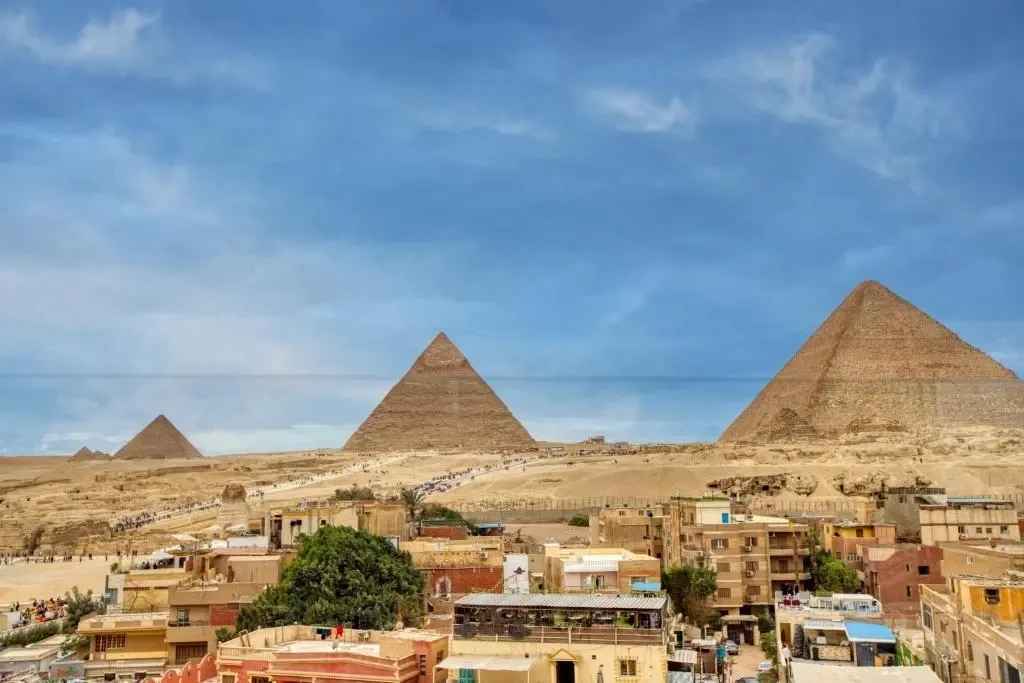
- Photographers – your room at the Mamluk Hotel offers a pyramid view at every hour of the day
Private vs. Group – What Actually Changes
There is no 50-seat coach. Your private Cairo tour from Hurghada runs in a modern air-conditioned vehicle, from a van for two people to a minibus for eight. Your guide is with your party alone. You decide where to linger, when to take a break and whether to swap something in the programme. There are no forced stops at papyrus, perfume or carpet factories unless you specifically ask for them.
Hurghada to Cairo Distance and Distance to the Pyramids
The first practical question before any Cairo tour from Hurghada is distance. Here are the exact figures.
Distance from Hurghada to Cairo
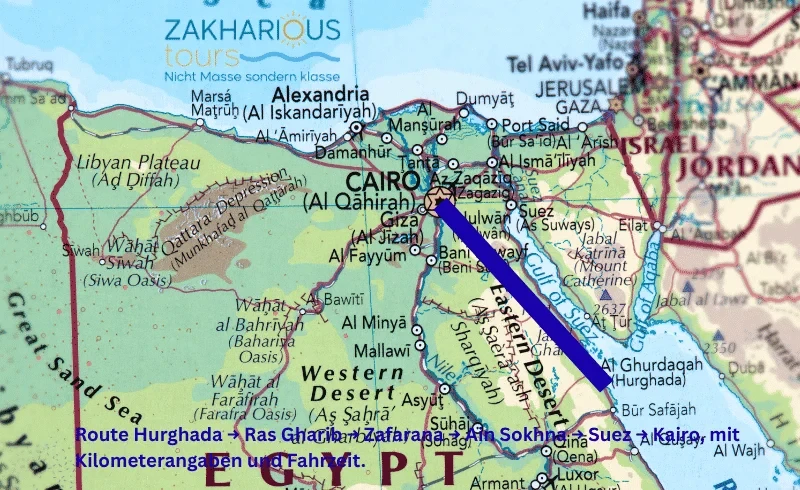
The Hurghada to Cairo distance is approximately 460 to 500 km (285 to 310 miles) by road; the straight-line distance is around 400–410 km (250 miles). Actual driving time is 5 to 6 hours depending on the route, Cairo traffic and rest stops. A domestic flight from Hurghada to Cairo takes about 45 minutes, but it rarely makes sense for a private touring trip because you then need transfers and a vehicle at the other end anyway.
The Route via Zafarana and Ain Sokhna
The standard road follows the Red Sea coast through Ras Gharib – Zafarana – Ain Sokhna – Suez and then joins the motorway into Cairo. The road is fully paved and well maintained. Along the way you pass the mountain ranges of the Eastern Desert and long stretches right beside the sea – at sunrise, a highlight in its own right.
Pick-Up Times and How the Drive Works
Pick-up is at your hotel at around 02:00–03:00 a.m. on day one, so you reach the Saqqara area by mid-morning and have the entire first day available. We stop at clean rest houses along the way. On day three we start the return drive in the late afternoon and arrive back at your hotel around 09:00–10:00 p.m.
Tip for the Night Drive
Ask reception for a breakfast box the night before and bring a light jacket – the air conditioning runs and desert nights are cooler than most holidaymakers expect. A neck pillow makes the first few hours considerably more comfortable.
Distance to the Pyramids – Everything Is Closer Than You Think
The good news: once you are in the Cairo area, the distances are short. That is exactly why this dense three-day itinerary still feels relaxed.
Distance from Cairo City Centre to the Pyramids of Giza
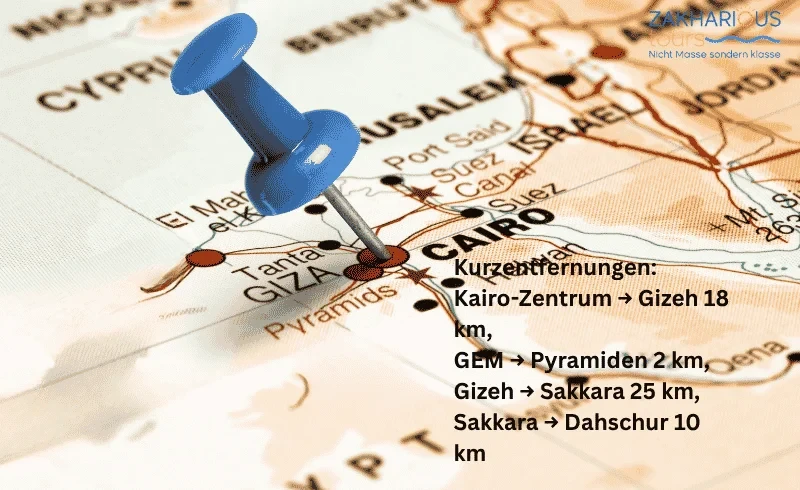
From central Cairo (Tahrir Square) to the Giza pyramid plateau is only about 18–20 km (11–12 miles). Depending on traffic the drive takes 30 to 60 minutes. Giza is effectively a district of Greater Cairo today – the desert begins immediately behind the last blocks of houses.
Distance from the Pyramids to the Grand Egyptian Museum
The Grand Egyptian Museum sits just 2 km (1.2 miles) from the pyramid plateau. From its vast glass façade you look straight at the Great Pyramid of Khufu – a setting no other museum in the world can offer.
Distances Between Giza, Saqqara, Dahshur and Memphis
- Giza → Saqqara: approx. 25–30 km (16–19 miles), about 40 minutes
- Saqqara → Memphis: approx. 4 km (2.5 miles), about 10 minutes
- Saqqara → Dahshur: approx. 10 km (6 miles), about 20 minutes
- Dahshur → Giza: approx. 40 km (25 miles), 50–70 minutes depending on traffic
- Giza → Citadel and Alabaster Mosque: approx. 20 km (12 miles)
- Alabaster Mosque → Coptic Cairo: approx. 5 km (3 miles)
- Coptic Cairo → Cave Church of St. Simon, Mokattam: approx. 8 km (5 miles)
Distance from Hurghada to the Pyramids of Giza
Because Giza lies on the western edge of the city, the Hurghada to Pyramids distance is around 500–520 km (310–325 miles), slightly more than to the city centre. On this tour we head straight for the Saqqara and Dahshur area on day one and continue to your hotel in Giza in the evening.
Itinerary: Hurghada to Cairo 3 Day Tour, Day by Day
As a private tour the programme stays flexible. The itinerary below is the one we recommend, and it can be tailored to your interests at any point.
Day 1 – Memphis, Saqqara, Countryside Lunch with a Carriage Ride in Dahshur and the Dahshur Pyramids
Pick-up at your hotel at around 02:00–03:00 a.m. and the drive via Zafarana and Ain Sokhna. Mid-morning you meet your English-speaking Egyptologist guide and begin exactly where the story of the pyramids actually starts – south of Cairo.
Memphis – Egypt’s Ancient Capital
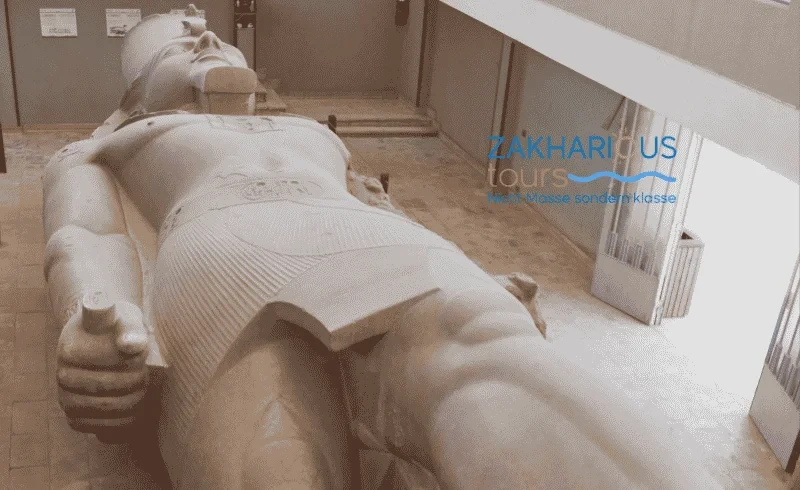
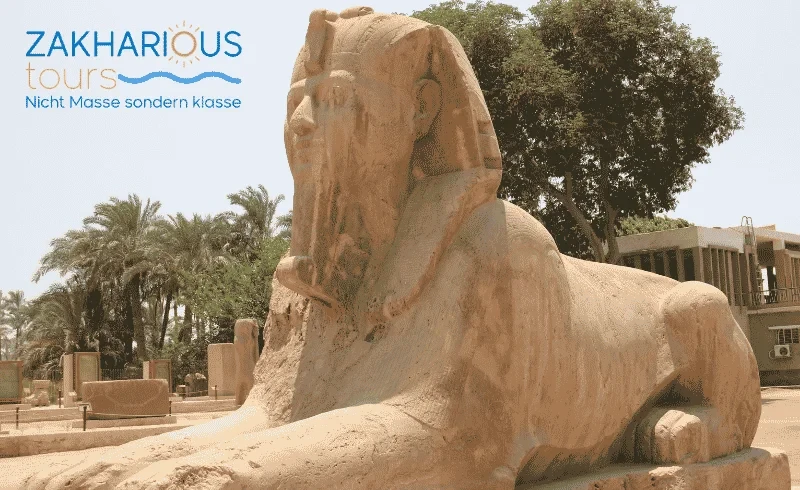
Memphis was the royal residence and capital of Ancient Egypt for more than 3,000 years, founded according to tradition by King Menes. In today’s open-air museum at Mit Rahina you see the enormous reclining colossus of Ramesses II carved in limestone, the Alabaster Sphinx of Memphis, and the remains of temples and royal statuary.
Why Memphis Is the Right Starting Point
Visiting Memphis before Saqqara makes the necropolis make sense: Saqqara was simply the cemetery of this city. Your guide draws that connection, so the stones become a story rather than a set of monuments.
The Necropolis of Saqqara – All Entrance Fees Included
Saqqara is the largest and oldest burial ground in Egypt and a UNESCO World Heritage Site. Unlike most operators, we include every entrance fee at Saqqara in the tour price – including the special tickets that are normally paid separately on site.
Djoser’s Step Pyramid – Entrance Included
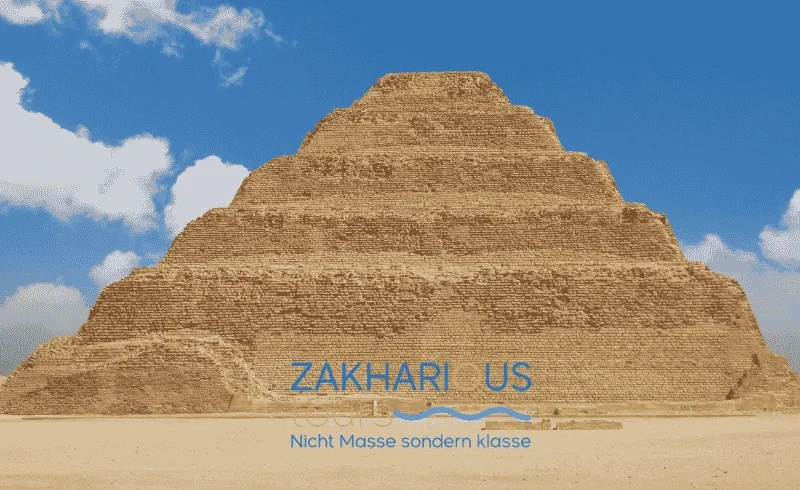
The Step Pyramid of Djoser from the 3rd Dynasty (around 2650 BC) is the oldest stone pyramid in the world and the first monumental stone structure in human history. Its architect, Imhotep, was later worshipped as a god. You explore the restored funerary complex with its colonnade and Heb-Sed court, and you go inside the pyramid itself – that entrance ticket is included.
The Serapeum of Saqqara – Entrance Included
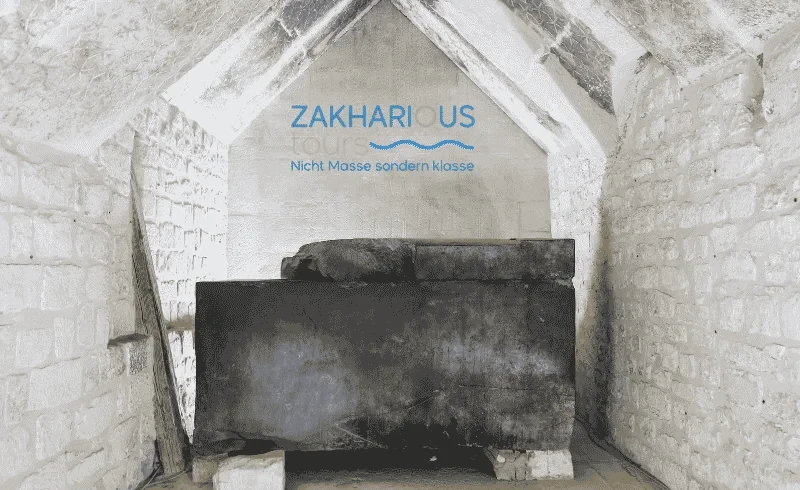
The Serapeum is one of Egypt’s most enigmatic sites: underground galleries containing giant granite sarcophagi weighing up to 70 tonnes each, built for the burial of the sacred Apis bulls. The precision of the stonework still astonishes every engineer who sees it. This normally extra-cost ticket is included in your price.
The Teti Pyramid and the Pyramid Texts – Entrance Included
From the outside the Teti Pyramid looks like a mound of rubble – inside, one of the best-preserved burial chambers in Egypt awaits, with a star-studded ceiling and the Pyramid Texts, the oldest religious writings known to humanity.
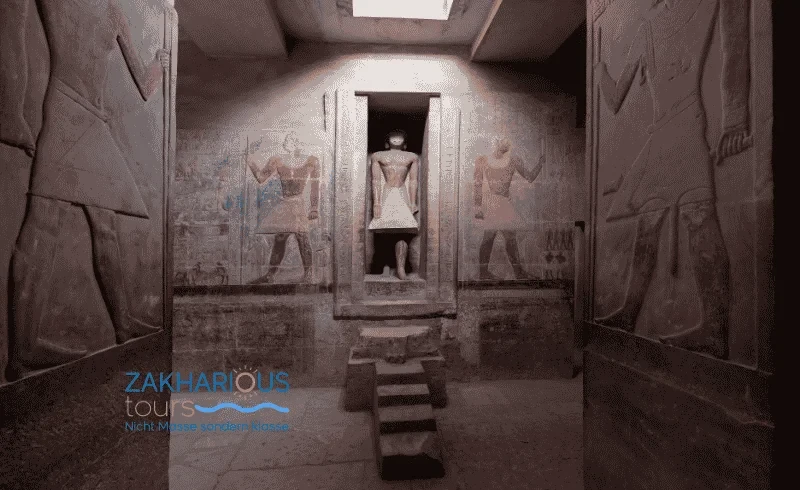
The Tombs of Mereruka and Kagemni – Entrance Included
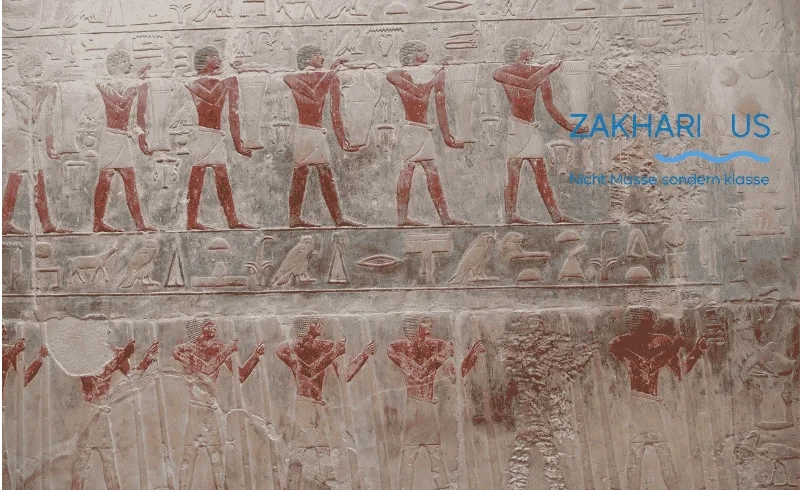
The two vizier tombs beside the Teti Pyramid are the finest relief tombs in Egypt. The mastaba of Mereruka has 33 chambers filled with painted scenes of fishing, hunting, craftsmanship, dance and music. The tomb of Kagemni contains extraordinarily lively depictions of animal husbandry, bird trapping and acrobatics. Both tickets are included.
Practical Note on the Burial Chambers
The descents into the Step Pyramid, the Teti Pyramid and the Serapeum are narrow, steep and warm in places. If you suffer from severe claustrophobia or back problems, it is better to wait outside – your guide will tell you exactly what to expect beforehand. Mobile-phone photography is permitted in most areas.
Countryside Lunch in Dahshur with a Horse-Carriage Ride
At midday we leave the desert for the green oasis of Dahshur, where a traditional countryside lunch awaits – freshly grown vegetables, home-made dips, baladi bread straight from the oven and grilled dishes, served by an Egyptian family in a palm garden.
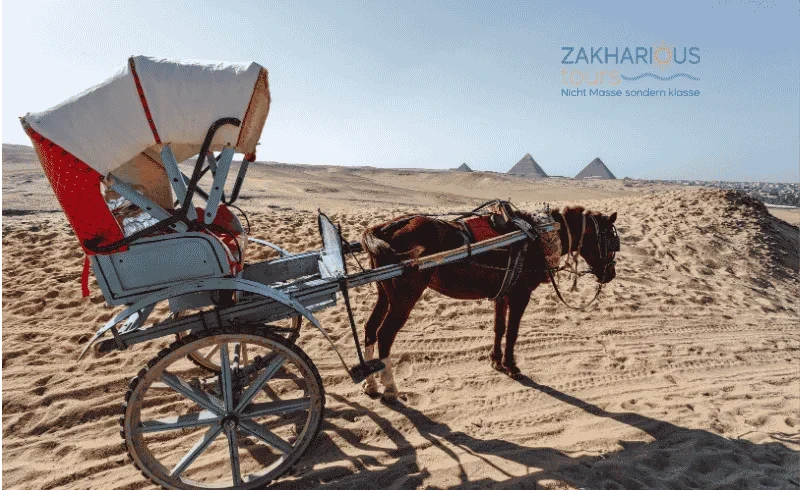
The Dahshur Carriage Ride – Included
Afterwards you set off by horse-drawn carriage through palm groves, fields and village lanes. This carriage ride is included in the price and, for many guests, is the loveliest and most unexpected moment of the whole trip: rural Egypt as it really looks away from the tourist trail – with the silhouette of the pyramids on the horizon.
The Pyramids of Dahshur
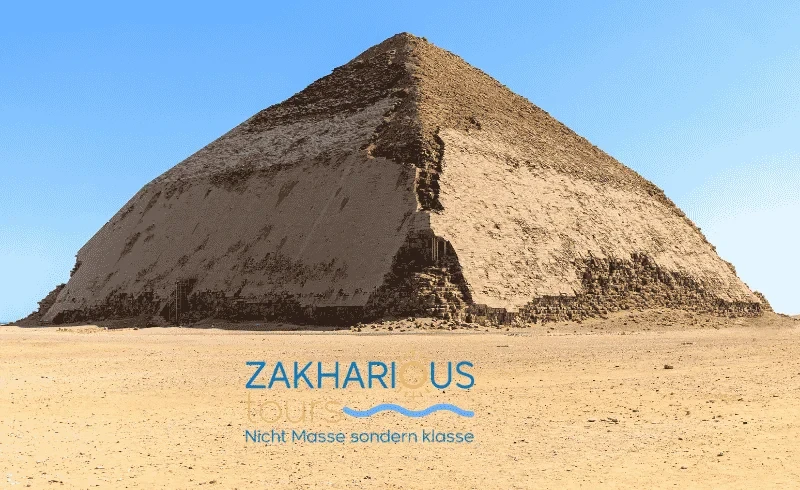
The Bent Pyramid
The Bent Pyramid of Pharaoh Sneferu is the only pyramid that changes its angle of inclination halfway up – visible proof of a construction experiment corrected while the building was going up. It is also the only pyramid that still retains most of its original limestone casing.
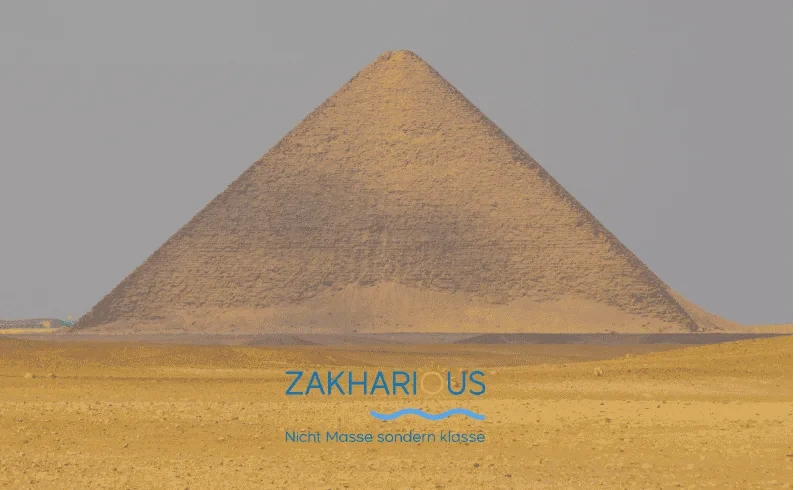
The Red Pyramid
The Red Pyramid, also built by Sneferu, is regarded as the world’s first true smooth-sided pyramid and the direct predecessor of the Great Pyramid of Giza. You can descend into its burial chambers and often find yourself almost alone inside a structure the size of a cathedral.
Check-In at the Mamluk Hotel Giza (4 Stars)
In the evening we drive to Giza and your hotel. You stay at the Mamluk Hotel, 4 stars, in a room with a direct pyramid view. Dinner at the hotel restaurant is included, with the floodlit pyramids in front of you. If you like, watch the Sound and Light Show at the Sphinx from the rooftop terrace (optional).
Day 2 – Pyramids of Giza, the Sphinx, Koshary at Abu Tarek, Old Cairo and Khan el-Khalili
After breakfast at the hotel comes the day most guests have been waiting for – and the drive takes just a few minutes.
The Giza Pyramid Plateau
The Great Pyramid of Khufu (Cheops)
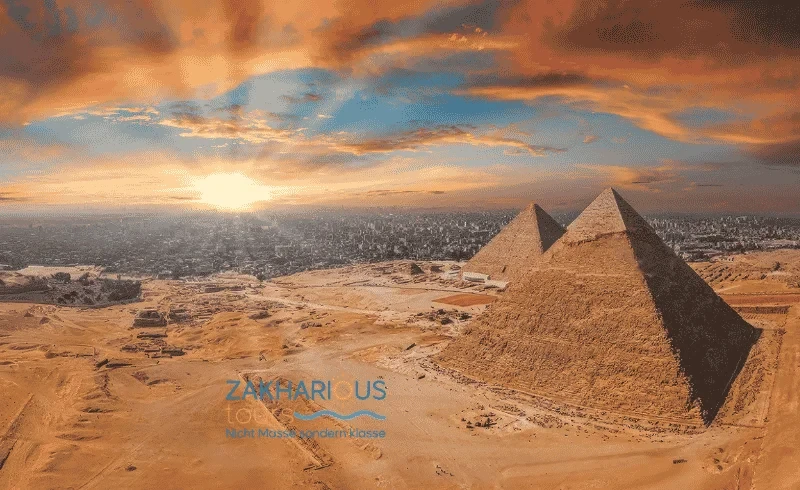
At an original height of 146.6 metres (481 ft), the Great Pyramid of Khufu was the tallest structure on Earth for almost 4,000 years and is the only surviving member of the Seven Wonders of the Ancient World. Around 2.3 million stone blocks, built about 2560 BC. After seeing Saqqara and Dahshur the day before, you immediately understand how this form evolved.
Optional: Going Inside the Great Pyramid
The climb through the Grand Gallery to the King’s Chamber is available with a separate ticket. The passage is narrow, steep and warm. Guides are not permitted inside, but yours will brief you thoroughly beforehand.
The Pyramids of Khafre and Menkaure
The Pyramid of Khafre looks taller than Khufu’s because it stands on higher bedrock – and it still wears its original limestone casing at the summit. The Pyramid of Menkaure is the smallest of the three, but it retains granite cladding around its base.
The Panoramic Viewpoint
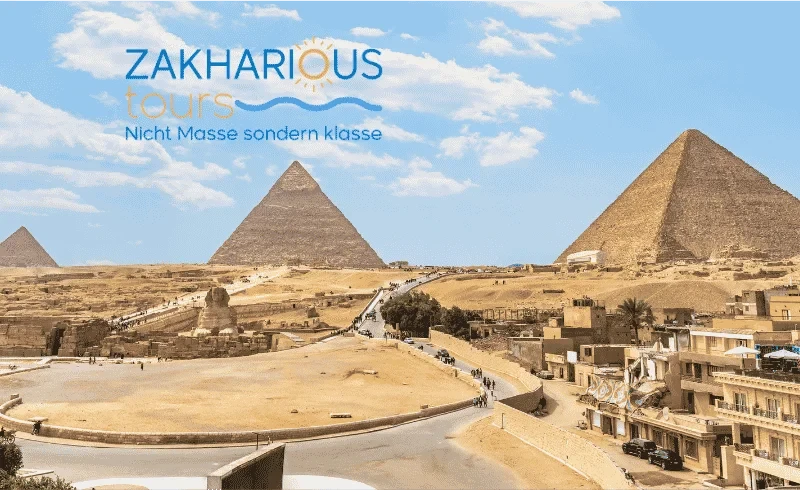
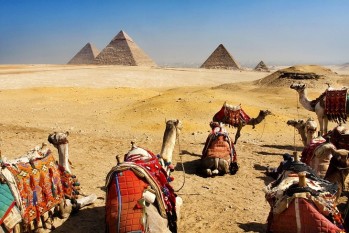
From the elevated viewpoint you see all three pyramids plus the queens’ pyramids lined up together – the classic Egypt photograph. This is also the best spot for an optional camel or horse ride in the desert.
The Great Sphinx and the Valley Temple
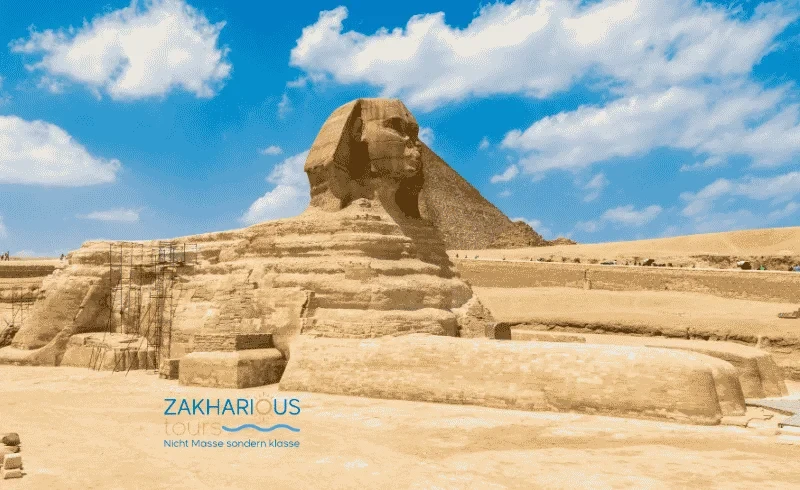
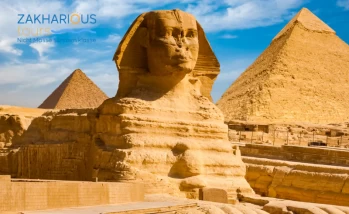
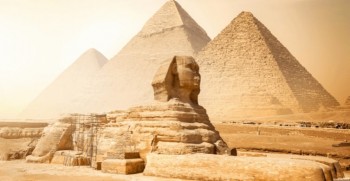
The 73-metre-long lion body with a king’s head guards the causeway to Khafre’s pyramid. Beside it stands the Valley Temple, built from monolithic granite blocks, where the mummification and purification rituals for the king once took place.
Lunch: Koshary at Abu Tarek
For lunch we drive downtown to Abu Tarek, Cairo’s most famous koshary restaurant – three floors and an institution for decades. Koshary is Egypt’s national dish: rice, macaroni, lentils, chickpeas, crispy fried onions, tomato sauce and garlic vinegar – vegetarian, vegan, filling, and for many guests the culinary surprise of the trip.
Old Cairo and the Khan el-Khalili Bazaar
In the afternoon you step into Islamic Cairo, the "city of a thousand minarets".
Khan el-Khalili – the Great Bazaar
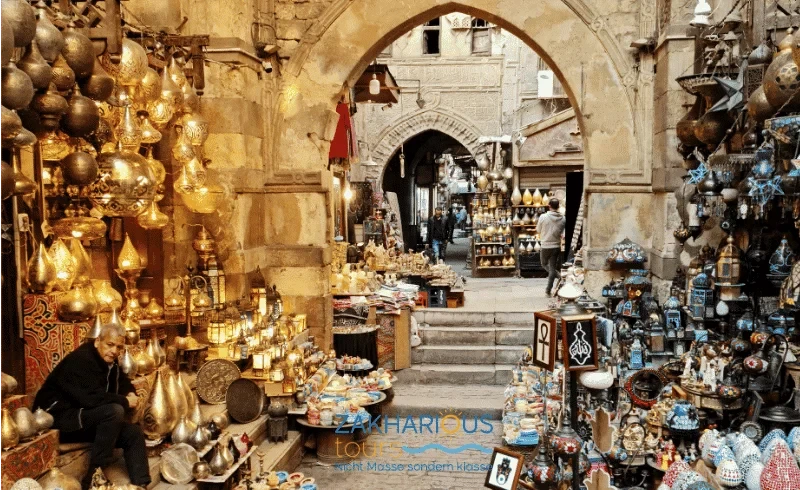
The Khan el-Khalili has been Cairo’s trading hub since the 14th century: spices, silver, alabaster, papyrus, copperware, perfume oils and textiles. Your guide shows you where the quality is genuine, translates and helps you bargain – with no obligation to buy anything.
Al-Muizz Street and the El-Fishawy Café
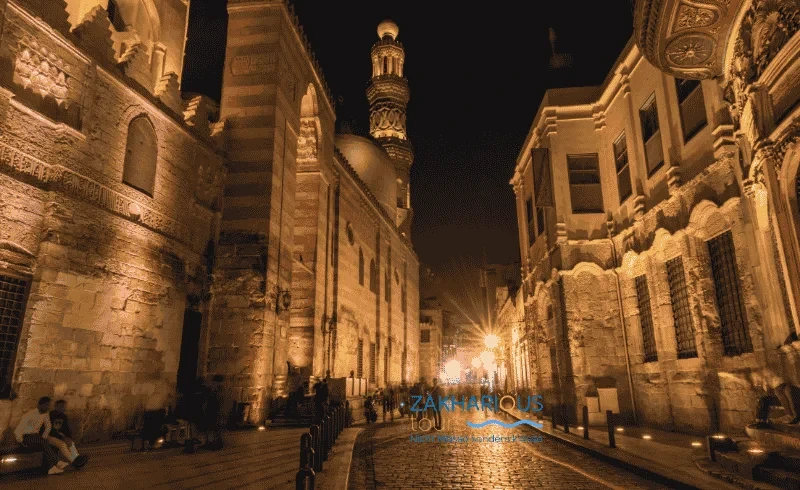
Al-Muizz Street is considered the largest concentration of medieval Islamic architecture in the world – mosques, madrasas, sabils and caravanserais from the Fatimid, Ayyubid and Mamluk periods. At the legendary El-Fishawy Café, where Nobel laureate Naguib Mahfouz once sat, you stop for mint tea or Turkish coffee.
Dinner at the Boutique Hotel Le Riad Hotel de Charme
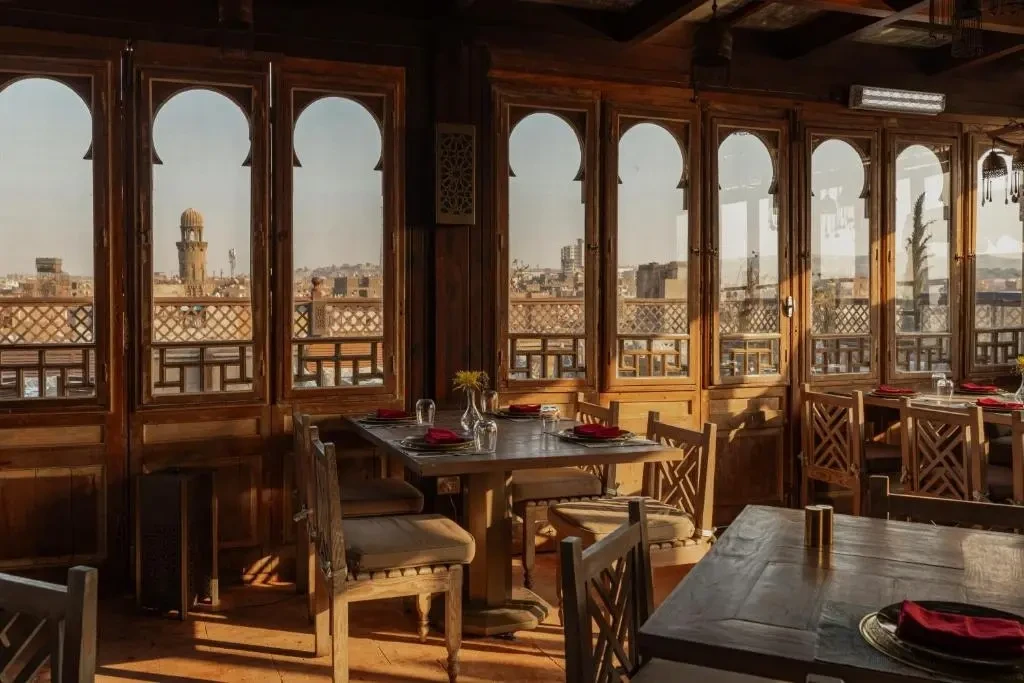
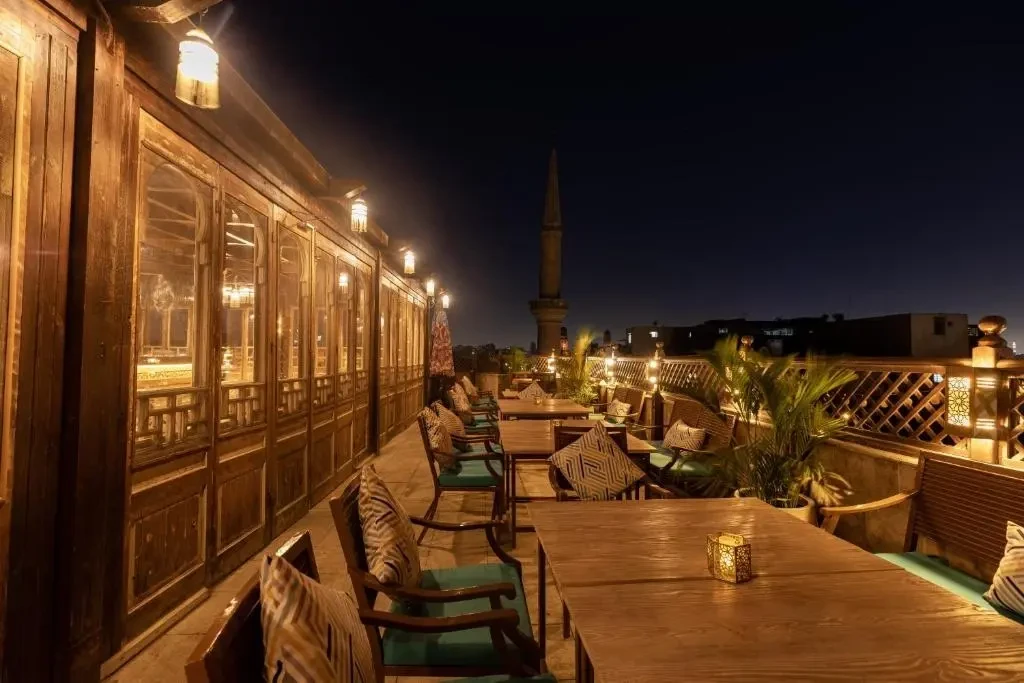
The evening ends at Le Riad Hotel de Charme, a boutique hotel on Al-Muizz Street. Dinner on the rooftop terrace, overlooking the domes and minarets of the old city, is included – one of the most atmospheric spots in Cairo and one that group tours almost never reach. Afterwards we return to the Mamluk Hotel in Giza.
Day 3 – Grand Egyptian Museum, Coptic Cairo, St. Simon Monastery and the Alabaster Mosque
After breakfast, the world’s most spectacular museum is first on the programme – and it is only two kilometres from your hotel.
The Grand Egyptian Museum (GEM) in Giza
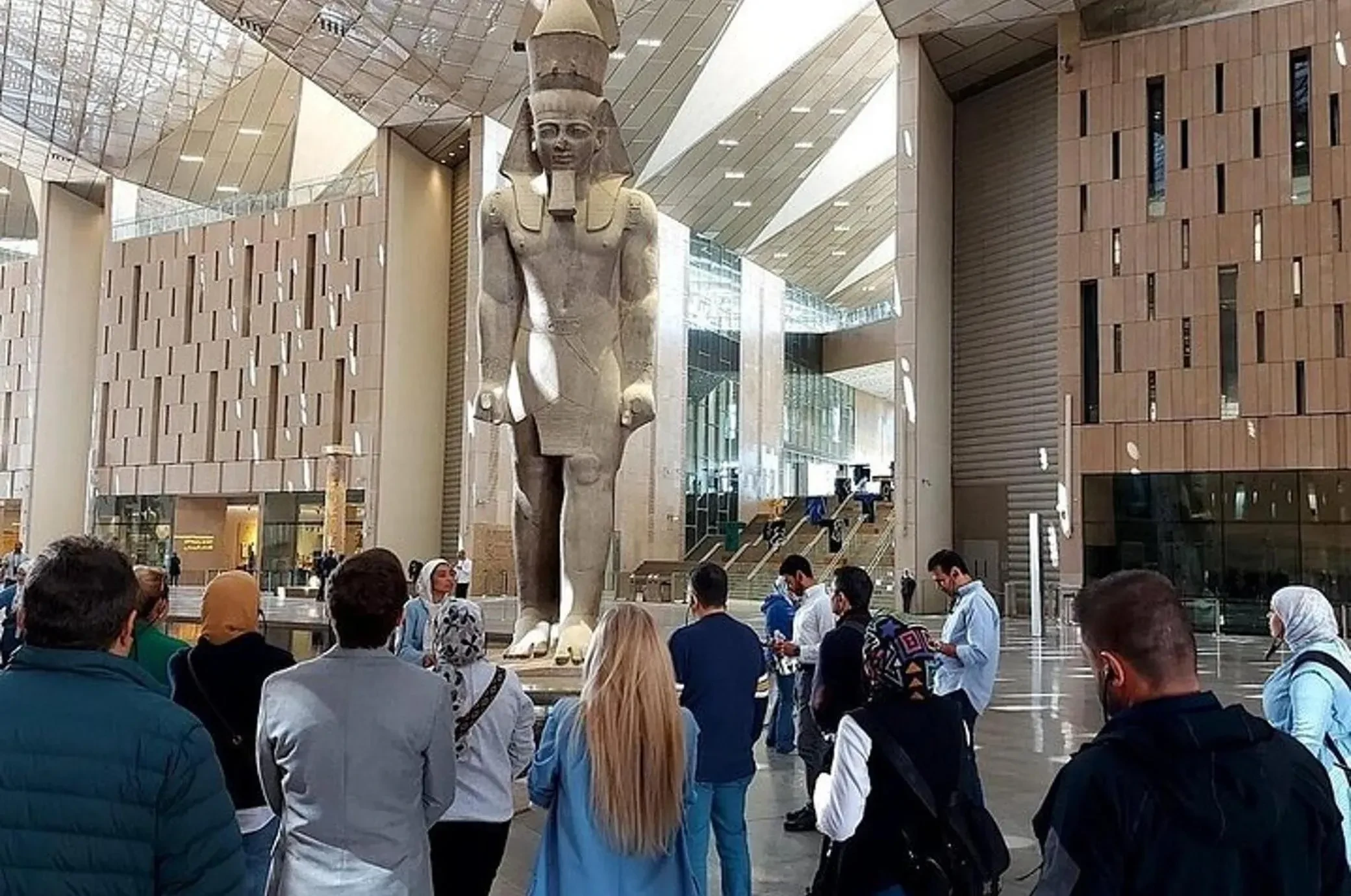
The Grand Egyptian Museum opened in full on 1 November 2025 and is the largest archaeological museum in the world devoted to a single civilisation. Across roughly 24,000 m² of gallery space you see more than 100,000 objects spanning prehistory to the Roman era.
The Grand Staircase and the Main Galleries
A six-storey staircase lined with royal statues, sarcophagi and columns carries you up through 3,000 years of history – and opens at the top onto a panoramic window framing the Pyramids of Giza. The twelve main galleries are arranged by period and theme: society, kingship and belief in the afterlife.
The Tutankhamun Galleries
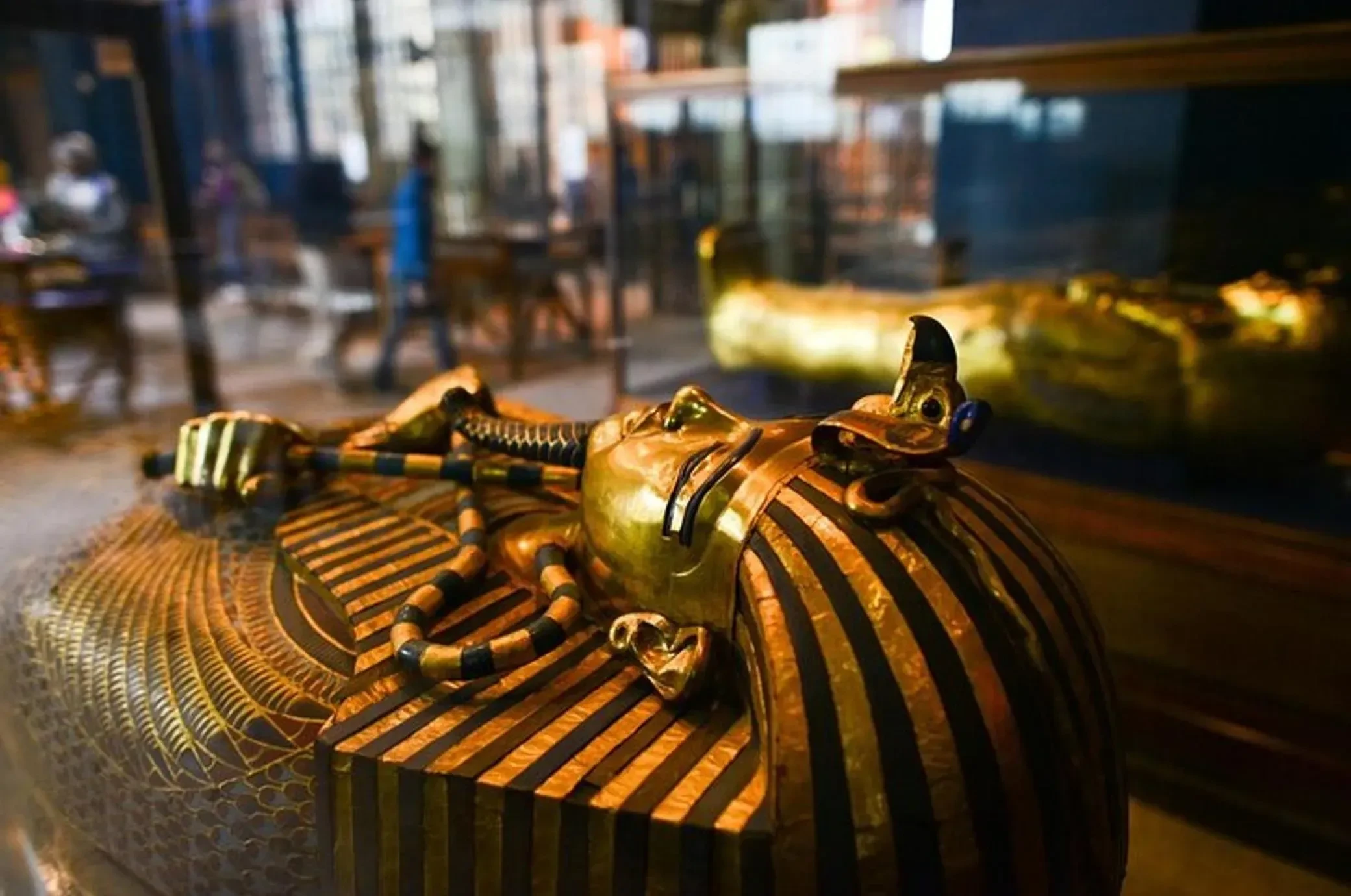
For the first time ever, the complete burial assemblage of Tutankhamun – all 5,398 objects – is displayed together: the golden funerary mask, the gilded shrines, the throne, the chariots and the jewellery. Your guide explains how the pieces relate to one another instead of marching you past display cases.
Practical Note for the Museum Visit
Allow at least three hours. Mobile-phone photography is permitted; some areas may require a photo pass. Comfortable shoes are essential – the walking distances inside the museum are long.
Lunch at the Mamluk Hotel
We return to the Mamluk Hotel for lunch, with the pyramid view from the restaurant. You then check out, and your luggage travels with us in the vehicle.
Coptic Cairo (Old Cairo)
In the afternoon you visit the Coptic quarter inside the walls of the Roman fortress of Babylon – where three world religions sit within a few hundred metres of each other.
The Hanging Church (Al-Muallaqa)
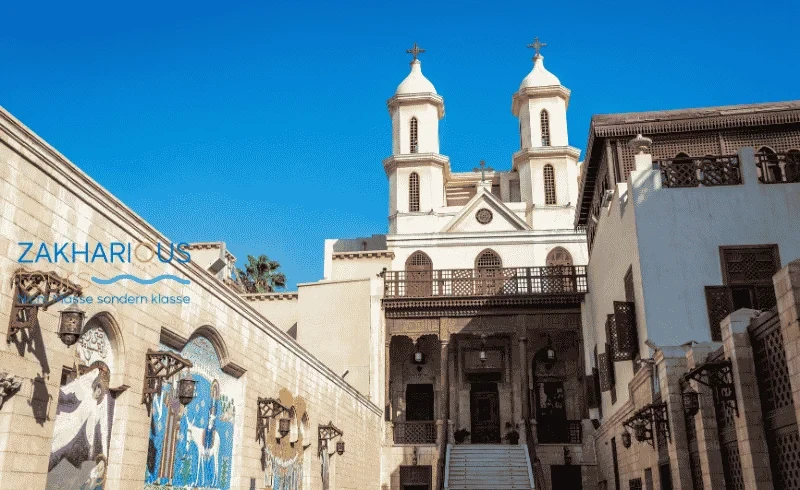
The Hanging Church rests on the bastions of the Roman fortress, which is how it earned its name. One of the oldest churches in Egypt, it holds more than 100 icons and a marble pulpit resting on 13 columns, and it is still in active use today.
The Church of St. Sergius (Abu Serga)
Beneath the Abu Serga Church lies the crypt where the Holy Family is said to have sheltered during the Flight into Egypt – one of the most important Christian pilgrimage sites in the country.
The Ben Ezra Synagogue
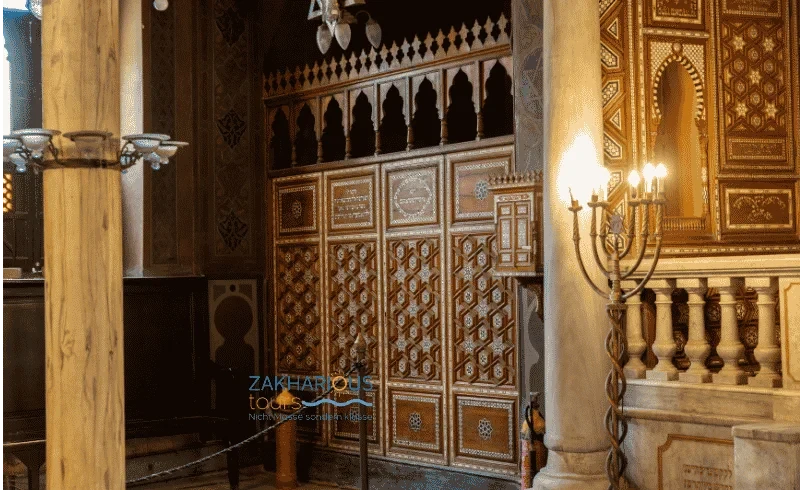
A few steps further stands the Ben Ezra Synagogue, the oldest synagogue in Cairo. It was here that the famous Geniza was discovered – a store of around 280,000 medieval manuscripts that transformed our understanding of Jewish life in the Middle Ages.
The Cave Church of St. Simon in Mokattam
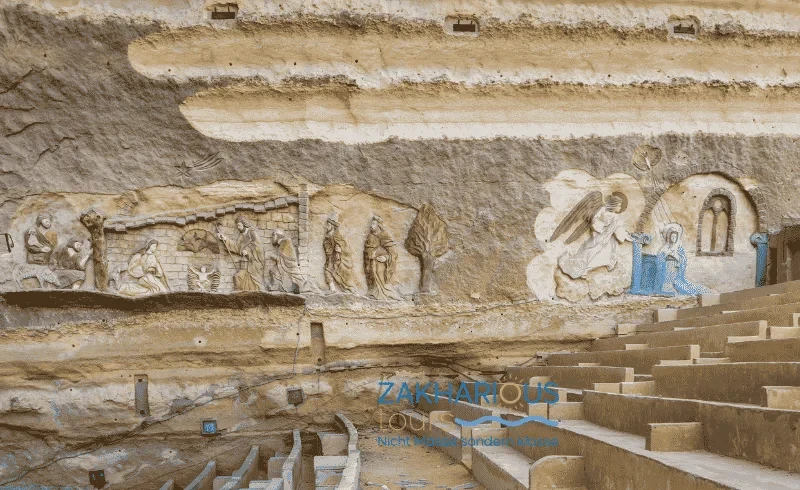
The Monastery of St. Simon the Tanner is carved into the Mokattam cliffs above Cairo. Cut directly from the rock, laid out like an amphitheatre and seating up to 10,000 people, it is the largest church in the Middle East. Enormous reliefs are sculpted straight into the cliff face, and the view over Cairo is extraordinary. Very few travellers know this place – and it is one of the most memorable stops on the entire tour.
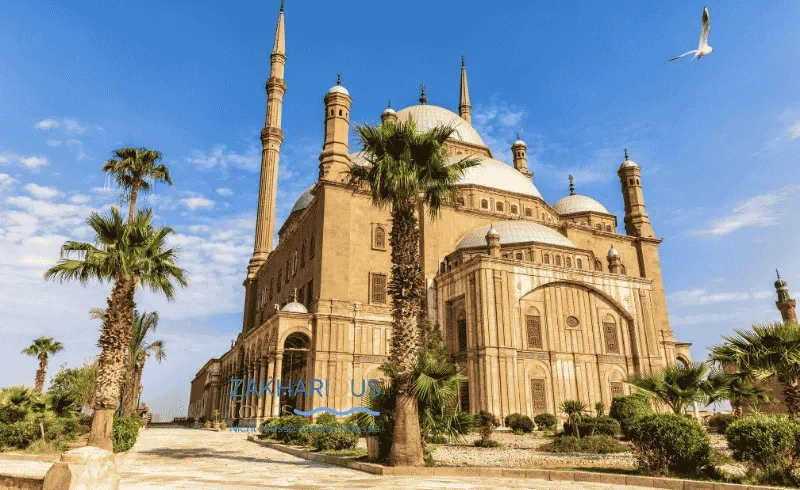
The Alabaster Mosque (Muhammad Ali Mosque) at the Citadel
You finish at the Alabaster Mosque inside the Citadel of Salah El-Din on the Mokattam hill. Built in Ottoman style in the 19th century, the mosque is clad in alabaster inside and out; the interior with its vast dome and central chandelier is one of Cairo’s most photographed sights. From the terrace you get the finest panoramic view over Cairo – on clear days as far as the Pyramids of Giza.
Dress Code for Mosques and Churches
Please cover shoulders and knees; ladies are offered a scarf at the entrance if needed. Shoes are removed before entering the prayer hall, so socks are worth having.
Return Drive to Hurghada
We begin the return journey in the late afternoon, arriving at your hotel in Hurghada, Makadi Bay, Sahl Hasheesh, Soma Bay, Safaga or El Gouna at around 09:00–10:00 p.m.
Write Your Own Review